
When Can Your Child Actually Feel What the Froggy Feels?
The surprisingly moving science behind when kids start to truly empathize with characters — and why it changes everything about the stories we choose.
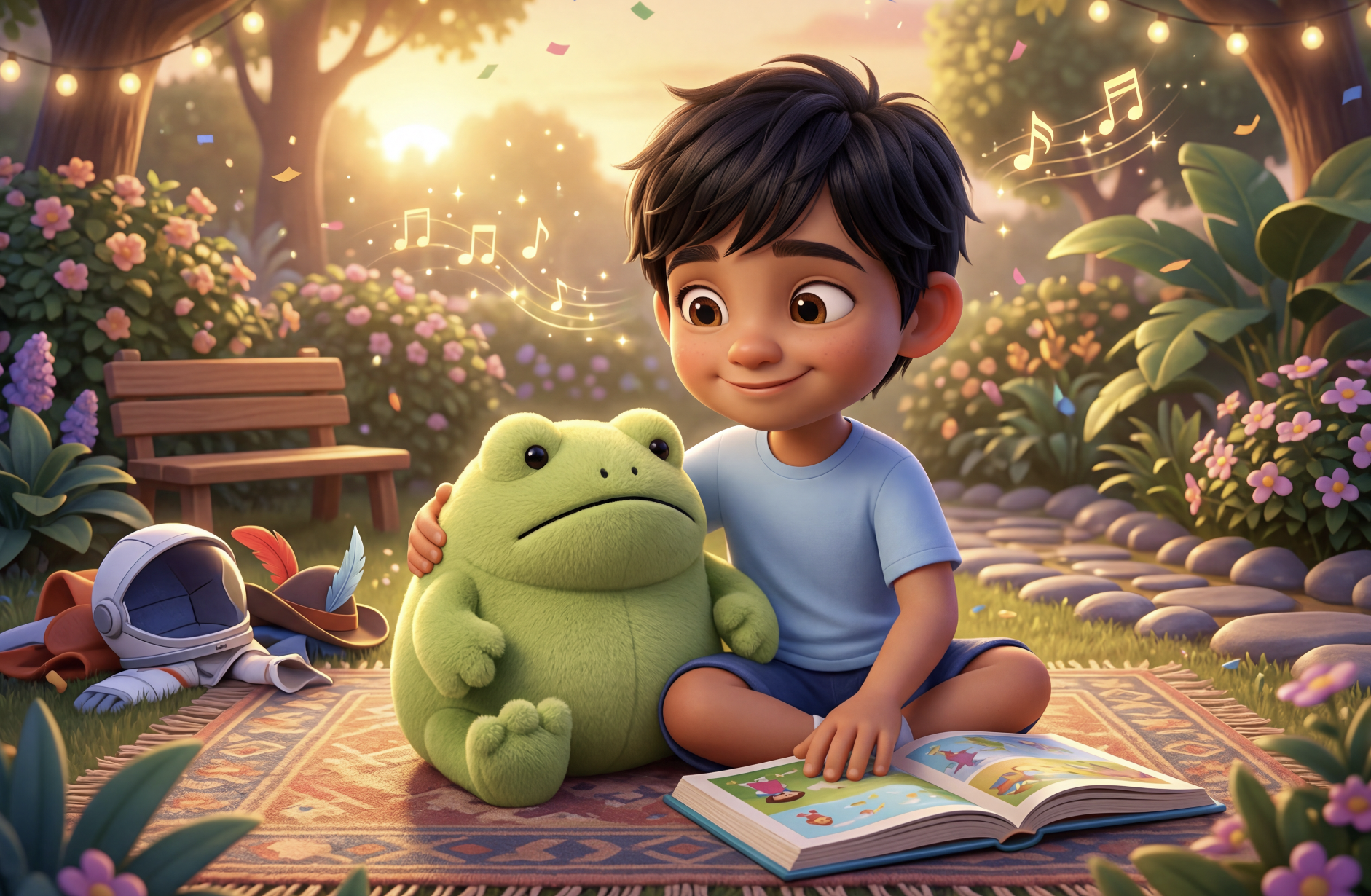
Somewhere around a child’s fourth birthday, an ability switches on that took researchers 178 studies to map: the capacity to understand that another person can believe something different from what you believe. Before it arrives, a story character’s fear mostly doesn’t compute. After it, a child can be afraid for someone. Which is why I pay such close attention to a certain kind of quiet at bedtime.
My 4-year-old is tucked in, we’re reading a story about a froggy who’s scared to go to the doctor, and when the froggy finally walks through the door and says “I can do this,” my son gets very quiet. Not distracted-quiet. Feeling-something quiet. And then he whispers: “the froggy was brave.”
For a long time I wondered whether the lesson was actually landing. Was he feeling what the froggy feels, the fear and the courage and the relief? Or was he just reporting plot, the way he’d report that the bus was yellow? The question matters, because if kids can truly step inside a character’s shoes and carry the froggy’s bravery back into their own life, then the stories we choose for them aren’t just bedtime entertainment. They’re shaping who our kids are becoming.
So I went looking for real answers, and some of what I found moved me more than I expected.
Empathy isn’t a light switch
Before the age-four story, though, a complication that makes it more interesting: empathy as a whole doesn’t switch on at all. Understanding another mind arrives fast. Caring for one is slower work, built from three abilities growing at different speeds and braiding together over years.
Jean Decety, a neuroscientist at the University of Chicago, described it as three components: the ability to feel what someone else feels (your heart racing when theirs does), the ability to understand what they feel and why, and the ability to manage your own response to their feelings. Each one develops on its own timeline.
So “can my kid empathize with the froggy?” is really three questions at once, and the answers arrive at different ages.
A small map of a very big journey
I want to walk through this age by age. Not because kids develop on a rigid schedule (they don’t), but because it helped me understand what my boys are actually capable of at each stage, and it made me a better storyteller.
The newborn months: feeling together, without knowing why. Babies cry when other babies cry. You’ve seen it; it’s one of the first things that happens in a hospital nursery. But this isn’t empathy. It’s emotional contagion: the baby isn’t feeling for the other baby, they’re picking up on distress the way you might flinch when someone else stubs their toe. Contagion is catching a feeling. Empathy is knowing whose feeling it is. This is the automatic, involuntary, very first building block.
Around 8 to 16 months: the earliest flickers. This is where it starts to get beautiful. A 2011 study found that babies as young as 8 months showed what researchers called “concern for others”: a worried look when someone nearby was upset, a tentative hand reaching out to touch them. These aren’t big gestures. They’re tiny, barely there. But they’re the first time a baby seems to register: something is wrong for that person, not just for me.
I think about my boys at that age, the way they’d toddle over and pat my face if I pretended to cry. They didn’t know what they were doing. But something in them was already wired to move toward another person’s pain instead of away from it. That still gets me.
Ages 2–3: big feelings, small words. This is the era of empathy with no instruction manual. A toddler can sense that someone is sad, and might bring you a blanket or offer their beloved stuffed animal, but they can’t yet understand why you’re sad, or that your sadness is different from theirs.
It’s also, not coincidentally, the most exhausting age, because they feel everything at full volume and can’t make sense of any of it. The rage of not being able to express yourself. The sadness that swallows you whole and then vanishes three minutes later. If you’ve lived through this stage, you know. It’s a lot, for them and for us.
Around age 4: the door opens. This is the finding I opened with, and it deserves its full weight. Psychologists call it theory of mind: the ability to understand that other people have thoughts, beliefs, and feelings that are different from your own.
Henry Wellman, a researcher at the University of Michigan, spent years studying when it arrives. His team analyzed 178 separate studies and found a striking pattern: children under about 3.5 consistently couldn’t grasp that someone else might believe something different from what they believed. But right around age 4, it clicked. Reliably. Across cultures, across different versions of the test.
For the froggy, it means this. At 3, your child hears the froggy is scared of the doctor and thinks: I’m not scared of the doctor, so why is the froggy? The froggy’s fear doesn’t fully compute. At 4, your child can hold two realities in their head at the same time: I’m not scared, but the froggy is, and that’s real for the froggy. They can step outside their own experience and into someone else’s.
That’s not a small thing. That’s the cognitive leap that makes stories work, really work, as tools for emotional growth.
Ages 4–7: the golden window. Once theory of mind arrives, it deepens fast. Kids in this range start to follow emotional arcs: not just “the froggy was scared and then the froggy was brave,” but why the froggy was scared, how the froggy found courage, and what that might mean for them the next time they face something hard.
This is the age when a story with real emotional shape (fear that builds, a turning point, a resolution that surprises) can genuinely change how a child approaches their own life. Not because you told them to be brave. Because they felt what brave feels like, from the inside of a story.
Ages 7–12: the world gets bigger. By middle childhood, empathy expands into new territory. Kids start to understand complex emotions: embarrassment, guilt, the strange feeling of being happy for someone and jealous of them at the same time. They can hold multiple perspectives. They begin to care about fairness and justice in ways that go beyond their immediate world.
The stories that resonate at this age get more layered too. The lessons aren’t as simple as “be brave” or “share your toys.” They’re about navigating friendship politics, understanding that good people sometimes do hurtful things, and learning that your perspective is one of many.
The beautiful reason animal characters work
One of my favorite findings in this literature explains something children’s authors seem to have always known. Scholars have found that animal characters give children something powerful: emotional distance. A child will empathize with a scared froggy without becoming overwhelmed, because the froggy is not them. It’s close enough to feel real (I’ve been to the doctor too) but far enough to feel safe. The fear is the froggy’s, not mine. I can look at it, sit with it, learn from it, without drowning in it.
A story about three little pigs losing their houses is a rollicking adventure. The same story about three children losing their homes is terrifying. The animal character creates a buffer, just enough space for a child to approach a hard feeling without being consumed by it.
The wrinkle is that distance cuts both ways. Research has also found that when it comes to actually carrying a lesson from a story into real life (sharing more after hearing a story about sharing, for example), human characters may have a slight edge. The emotional distance that makes animal characters safe can also make the lesson feel a little more abstract.
Why personalized stories hit differently
And this is where I started to understand something about what we’re building at Enchantably.
The research says two things that seem like they’re in tension but actually aren’t. First: emotional distance (through animal characters, fantasy settings, unfamiliar worlds) helps kids approach hard feelings safely. Second: personal connection (seeing yourself in the story, recognizing your own world) helps lessons transfer to real life.
The magic of a personalized story is that it gives a child both at the same time.
The froggy is still a froggy. The adventure is still fantastical. The emotional distance is intact. But then the child’s name appears on the page. Their favorite stuffed animal is the sidekick. The setting looks like their world. And suddenly the distance collapses — not in a scary way, but in a recognition way. That’s me. I’m in this story. This is about me.
The child gets the safety of fiction and the power of personal connection in the same breath. They can feel the froggy’s fear without being overwhelmed by it, and they can carry the froggy’s courage directly into their own life, because the story already told them it was theirs.
I thought about this constantly while building Enchantably’s Safety Magic stories, the arcs that teach kids important safety lessons: what to do if they get lost, how to handle a stranger situation, when to tell a trusted adult.
Those topics are heavier. The emotional stakes are real. And for some kids, especially the deeply empathetic ones who feel everything, putting them at the center of a scary scenario could be too much. The lesson wouldn’t land because the fear would swallow it.
So we built in a choice. In Safety Magic stories, your child can be the hero — or their favorite toy or pet can go through the lesson instead.
It’s the emotional distance research in action, designed into the product. A sensitive child who would freeze up reading about themselves getting lost might follow along beautifully when it’s their stuffed elephant navigating the situation. The lesson is identical. The safety information is the same. But the child gets to learn it from one step back: close enough to absorb it, safe enough to stay open.
And for the kids who are ready to be the hero? They can be. It’s their story either way.
I don’t think that’s a gimmick. I think it might be exactly what the science suggests kids need: stories that are close enough to feel real and safe enough to let them practice.
What this means for the books on your shelf
What I take from all of this, as a parent and as someone who builds stories for a living: the stories we read to our kids between about 4 and 7 aren’t just entertainment. They’re doing real emotional work. Every story with a character who feels something hard, moves through it, and comes out changed on the other side is giving your child a rehearsal for their own life. It’s empathy practice, and the research says it genuinely matters.
You don’t need to overthink it, and you certainly don’t need to turn bedtime into a developmental exercise. Just choose stories with an emotional heartbeat: stories where something real is at stake for the character, where the resolution isn’t too easy, where there’s room for your child to feel the journey.
And if your child gets very quiet at the end and whispers something about the froggy being brave, know that a real cognitive event just occurred, one you can’t see or measure or rush. They felt the froggy’s fear and borrowed the froggy’s courage. They’re carrying it now.
The understanding switches on around four. The practice takes the rest of childhood.
A note on sources: The research referenced in this post draws from peer-reviewed work including Decety (2010) in Developmental Neuroscience, Wellman, Cross & Watson’s 2001 meta-analysis of 178 studies in Child Development, Roth-Hanania et al. (2011) in Infant Behavior and Development, Larsen et al. (2018) in Developmental Science, and Kucirkova (2019) in Frontiers in Psychology. Full citations are available on request.
Ready to Create Something Magical?
Discover personalized storybooks starring your child's favorite toy, pet, or loved one.
Explore the Magic TodayJoin the Conversation
When did you first notice your child really feeling for a character — not just narrating, but genuinely moved? What was the story? I always want to know.