Every Book Has a Cost. Here’s How I Think About Mine.
On paper, compute, full bookshelves, and trying to leave things better than I found them.
Every book has an environmental cost. Most children’s book companies don’t talk about theirs, and most AI companies definitely don’t talk about theirs. I run a company that is both, so I’d like to go first: what Enchantably costs, what I’m doing about it, and where I still have questions.
The word I keep reaching for is impact, which slide decks have nearly ruined. So let me define my terms. Impact-washing is what a company claims. Impact is what it pays for. This post is my attempt at the second kind, the kind that keeps me up at night wondering whether the thing I’m building makes the world slightly better or slightly worse.
The bookshelf problem
Look at your bookshelf right now. The kids’ section. How many of those books have been read more than twice?
I’ll go first: mine is full of beautiful, well-intentioned books that my boys opened once, maybe twice, and never touched again. Gorgeous hardcovers with thick, coated paper. Spines uncracked after the first read. Forty pages of high-quality stock, printed, shipped, shelved, and forgotten.
I love books. I love physical books. I love the weight of them in a child’s hand, the ritual of turning pages, the way a bedtime story feels different when it’s a real object between you. I’m not here to argue against any of that.
But I am here to say: there’s a cost to a book nobody reads. Paper. Ink. Water. Energy. Shipping. The entire supply chain that moves a physical object from a printing press to a shelf where it sits, doing nothing, until it eventually gets donated or thrown away.
The children’s book industry produces hundreds of thousands of new titles every year. Some become beloved. A lot don’t, and the ones that don’t used the trees and burned the fuel anyway. You’d assume that in a business like mine, the AI is the guilty party. Some days it is. But the cost I can’t stop seeing is the quieter one: the beautiful object nobody opens twice.
The AI cost I can’t pretend doesn’t exist
Enchantably uses AI, which means the mirror turns on me next. Every story generated, every illustration created, every personalized book that comes to life on your screen takes compute. Servers running. Energy consumed. A carbon footprint that’s real even if it’s invisible.
I’m not going to sit here and pretend that digital means free. It doesn’t. AI models require enormous amounts of energy to train and to run. Every time Enchantably generates a story, there’s a cost to the planet that doesn’t show up on the receipt.
I hold that tension honestly. I’m building on a technology with a real environmental cost, and I believe what I’m building is worth it. But “worth it” is not the same as “free of consequence.” It means I have a responsibility to minimize the cost and offset what I can’t eliminate.
One really good book can replace ten that go unread
The principle I test every decision against is a claim about reading, not a feeling about trees:
A personalized book that a child asks to hear every single night, because their name is in it and their bear is the sidekick, replaces a stack of books bought on hope and abandoned after one read.
I’m not saying Enchantably replaces all physical books. I’m saying that when a book is built around a specific child, for a specific moment in their life, the odds of it being loved and reread go up dramatically. The greenest book isn’t the one printed on the nicest recycled stock; it’s the one that actually gets reread. Every book loved instead of shelved is a small win for a planet that doesn’t need more beautiful objects collecting dust.
On the technical side, I’m constantly working on the algorithm to minimize redundant generation: fewer re-runs, a more efficient AI, getting closer to the right output in fewer attempts. It is, to put it kindly, a work in progress. But the intention is baked into the engineering: generate less, generate better.
The dream job I haven’t gotten yet
I’ve always said that my dream job is to sit on the board of the World Wildlife Fund.
That probably sounds like a non sequitur in a blog post about children’s books. But it’s actually the through-line of everything I care about. I love animals. Deeply, viscerally, in a way that has shaped how I see the world since I was a kid. I believe all living things deserve a full, complete, joyful life. Not just humans, not just the charismatic ones, all of them. The ones in the rainforest and the ones in the reef and the ones in the backyard that nobody writes children’s books about.
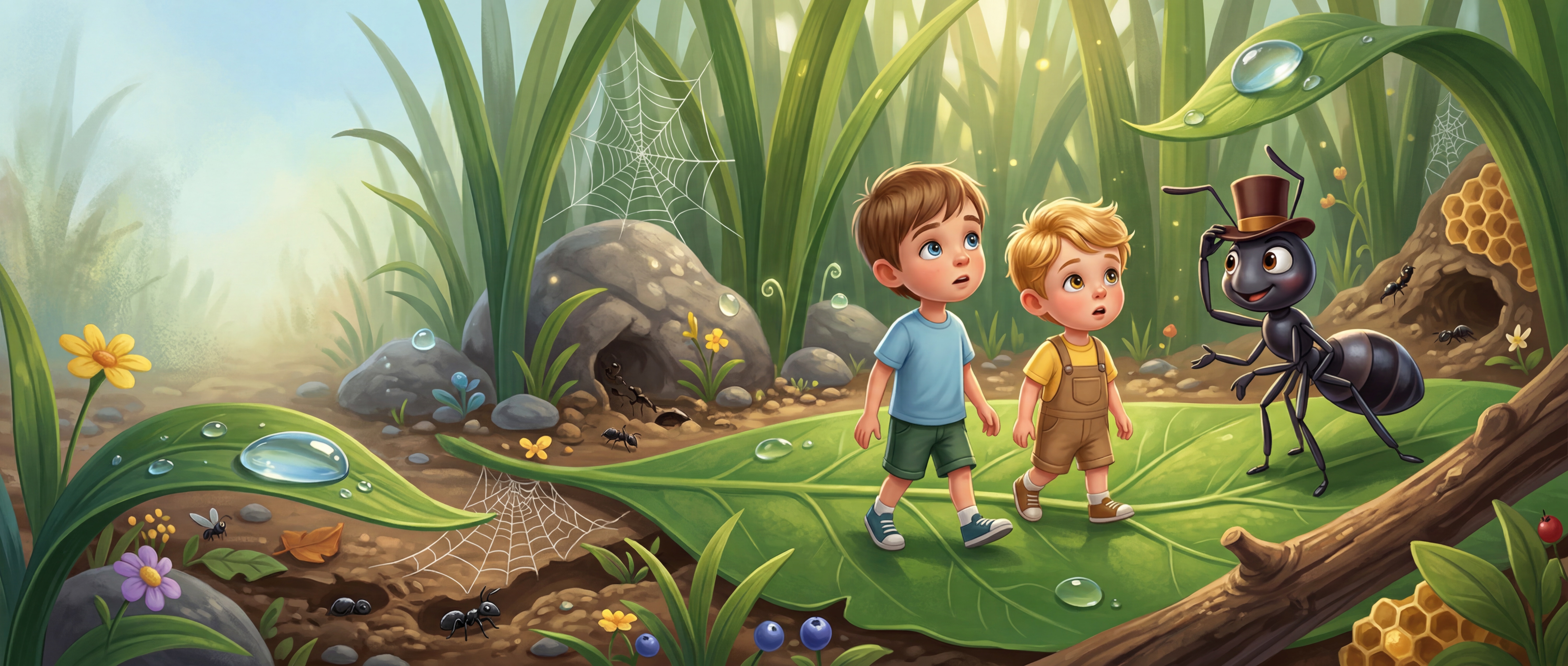
(About that last one: I couldn’t resist. There’s a story on Enchantably called The Tiny Protectors where a magical dewdrop shrinks a child to the size of an ant, and they discover that the backyard they’ve been stomping through is actually a whole civilization: ant highways, a bee’s palace, a spider’s impossible bridge. They grow back changed. They step softer. They see what they couldn’t see before. That one is basically a love letter to every small creature I’ve ever wanted my boys to notice.)
That belief isn’t separate from Enchantably. It’s the root system underneath it.
So let me put my commitment in writing, in public:
10% of all Enchantably profits will go directly to WWF.
Real money, going to an organization that protects the living world that my kids, and yours, are going to inherit.
This isn’t a one-time campaign or a limited promotion. It’s a permanent part of how Enchantably operates. Because if I’m going to use compute and energy to make something, the least I can do is put a portion of what it earns back into the planet that’s footing the bill.
Building something for the community, not just from it
The second commitment is closer to home. I’m working with schools to share proceeds from book sales with their PTAs. The idea is simple: when a school community discovers Enchantably and parents buy books through that connection, a portion of the proceeds goes back to the PTA, the people organizing the bake sales and the field trips and the classroom supplies that never seem to have enough funding.
This isn’t charity. It’s alignment. The same parents buying personalized books for their kids are the ones volunteering at school pickup and running the spring fundraiser. The money should circulate back to them. It should strengthen the community it came from.
I’m starting with my kids’ school as I’m still building out the details of how this works at scale, and I’ll share more as it takes shape. But the principle is already in motion: Enchantably isn’t here to extract from communities. It’s here to be part of them.
Why I’m telling you this
I could have quietly donated to WWF and never mentioned it. I could have set up the PTA partnership without writing a blog post about it. There’s a version of this where I just do the right thing and keep my mouth shut.
But I think transparency matters more than modesty right now, especially in AI.
People are rightfully skeptical of AI companies making claims about impact. The industry has earned that skepticism. So rather than asking you to trust that I care, I’d rather show you exactly how I’m thinking about it, where I’m falling short, and what I’m doing to close the gap.
I don’t have it all figured out. I’m one person, building a small company, trying to make children’s books that are worth a child’s attention and worth the resources it takes to create them.
But I’m here to do good: to bring relief, and connection, and love, and to leave the actual, physical, breathing world a little better than I found it.
That’s not a marketing message. It’s just what I’m trying to do.
Ready to Create Something Magical?
Discover personalized storybooks starring your child's favorite toy, pet, or loved one.
Explore the Magic TodayJoin the Conversation
What causes matter most to your family? If you could point a portion of a purchase toward something — animals, oceans, education, hunger — what would it be? I’m always listening.